How to choose
Which smart pet device actually replaces a chore
Feeders, fountains, cameras and trackers solve four different problems. Compare them on cost per year and on the job each one genuinely removes.
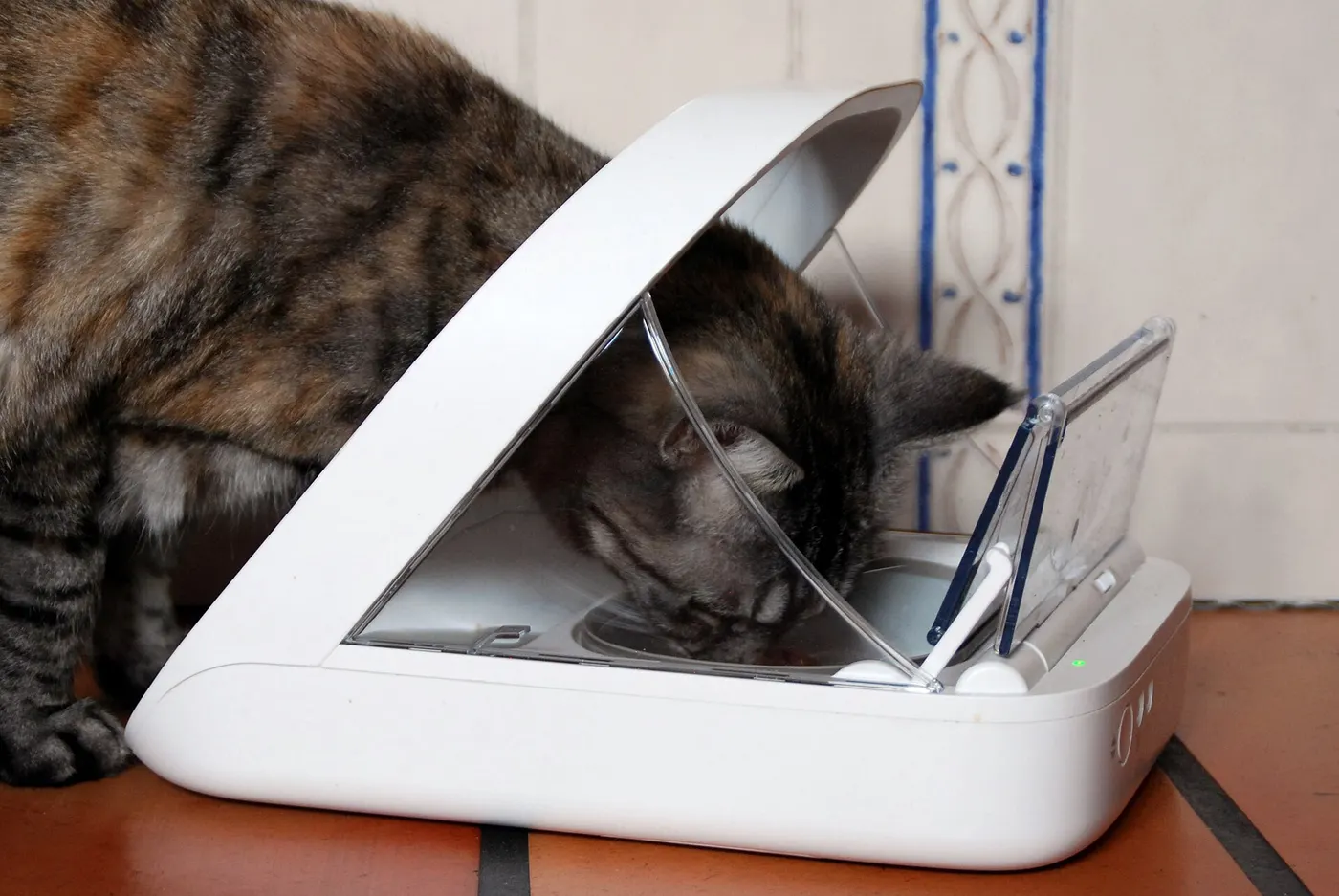
Smart pet gear is sold as a category, but the four common devices answer unrelated questions. A feeder answers 'who feeds the cat at 7am'. A fountain answers 'will this animal drink enough'. A camera answers 'what happens while I am out'. A tracker answers 'where did the dog go'. Buying the wrong one is not a quality problem; it is a question problem.
This guide prices each one over 4 years using the cost per year calculator's arithmetic — purchase price, minus any resale, plus consumables for each year, divided by the years. Every figure is a worked example, because this site has no price feed and runs no tests.
Start from the chore, not the device
Write down the thing you are actually trying to stop doing, and how many times a week you do it. Feeding twice a day is 14 events a week. Topping up a water bowl is perhaps 7. Checking on an anxious dog is whatever you currently do. Finding a cat that goes outside is, for most households, a handful of frightening events a year rather than a daily task.
That frequency is what decides the value, and it is also what decides the failure cost. A feeder that jams means a missed meal, which matters daily. A tracker whose battery is flat means nothing at all until the one day it means everything. Those two devices therefore need different habits from you, not just different budgets.
The second filter is the animal. A cat that grazes needs a different feeder from a dog on two measured meals. A long-haired cat that will not drink from a still bowl is the clearest case for a fountain there is. An escape-prone dog in a fenced yard is a camera question; the same dog off-lead on walks is a tracker question.
| Device | Chore removed | Events per week | Cost of a failure |
|---|---|---|---|
| Automatic feeder | Scheduled feeding | 14 | A missed meal that day |
| Water fountain | Refilling and cleaning a bowl | 7 | A bowl that needs filling by hand |
| Indoor camera | Wondering, and checking in person | Varies by household | You find out later instead of now |
| GPS tracker | Searching when an animal is loose | A few times a year | No position at the one moment it matters |
Event counts assume twice-daily feeding and daily water changes. Put your own counts in; a household that already feeds on a strict schedule gets less from a feeder than one that does not.
Cost per year, with the subscription included
The purchase price is the smaller half for two of these four devices. A $120 feeder with about $18 a year of batteries and desiccant costs ($120 + $18 × 4) ÷ 4 = $48 a year over 4 years. A $70 camera on a $3 monthly cloud plan is $36 a year of plan, so ($70 + $36 × 4) ÷ 4 = $53.50 a year — more than the feeder, despite costing $50 less to buy.
A $100 tracker on a $6 monthly plan is $72 a year of subscription, giving ($100 + $72 × 4) ÷ 4 = $97 a year. Over the 4 years that is $388 in total, of which $288 is the plan. A $60 fountain with a $4 filter every 30 days needs 365 ÷ 30 = about 12.2 filters a year, which is $48.67, so ($60 + $48.67 × 4) ÷ 4 = about $64 a year.
The ranking by purchase price is fountain, camera, tracker, feeder. The ranking by cost per year is feeder, camera, fountain, tracker — almost reversed. That inversion is the single most useful thing to know before buying any of them.
| Device | Example price | Consumables or plan per year | Total over 4 years | Cost per year |
|---|---|---|---|---|
| Automatic feeder | $120 | $18 | $192 | $48 |
| Indoor camera | $70 | $36 | $214 | $53.50 |
| Water fountain | $60 | $48.67 | $254.67 | about $64 |
| GPS tracker | $100 | $72 | $388 | $97 |
Each total is price plus four years of consumables; cost per year divides that by 4. Fountain filters are $4 every 30 days, which is 365 ÷ 30 = about 12.2 a year. These are example prices to show the arithmetic, not quotes.

The question to ask before the price: how long will it be supported
Three of these four devices stop working properly if the manufacturer's app or service ends. That date is almost never published. Federal Trade Commission staff looked at 184 connected products and found that nearly 89% did not disclose on their websites how long the product would receive software updates; 161 of the 184 gave no support duration or end date at all, and a basic internet search found nothing for 124 of them.
The FTC's consumer advice is direct: look for the support duration on the product or manufacturer's website before buying, and if it is not there, ask the manufacturer by phone, email or chat. An unanswered question is itself an answer for a device you are planning to depend on for 4 years.
This changes the arithmetic above in one specific way. If the tracker's service ends after 2 years rather than 4, you have spent $100 plus two years of plan, which is $244, and it bought 2 years rather than 4 — an effective $122 a year instead of $97. A mechanical timer feeder has no such risk, which is a real argument in its favour even though it does less.
- Find the support end date on the manufacturer's product page before you compare prices
- If it is not published, ask the manufacturer directly and keep the reply
- Ask what the device still does with no network and no subscription
- Check whether the plan is per device or per household, which decides what a second animal costs
- Prefer the version with a local mode for anything whose failure matters the same day
What the price index says about the category
In the U.S. Bureau of Labor Statistics consumer price index, pets and pet products rose 1.3% over the 12 months to September 2026, and pet food and treats rose 1.5%. Neither is dramatic, and neither is a reason to wait for a better moment.
What those figures do tell you is that the hardware is not where a pet budget is growing. On the example above, a feeder costs $48 a year while the food going through it costs several times that for most households, and a 1.5% rise in food is a larger annual change than a 1.3% rise in the device you would buy once.
It also sets expectations for the used market. Pet hardware depreciates hard because hygiene matters to buyers, so a second-hand feeder or fountain sells for a fraction of its price. Buy new if the part that touches food or water cannot be replaced.
Before you buy
- Write down the chore you want removed and how many times a week it happens
- Add the monthly plan to the purchase price and divide the total by the years you expect to keep the device
- Find the published software support end date, or ask the manufacturer for it and keep the answer
- Ask what each device still does with no network and no subscription
- Check the minimum portion size and number of daily meals before buying any feeder
- Take the filter interval from the manufacturer's instructions and cost a full year of it
- Check that the parts touching food or water can be removed and cleaned
Questions readers ask
- Is a tracker a substitute for a microchip?
- No, they do different jobs. A tracker reports a live position and needs power and a network; a microchip stores an identity number and needs a scanner at a vet or shelter. One finds an animal that is loose now, the other reunites an animal that someone else has already picked up, which is why households with outdoor animals usually end up with both.
- Do automatic feeders work for cats that graze?
- Only if the feeder dispenses small portions many times a day rather than two large ones. Check the minimum portion size and the maximum number of scheduled meals before anything else, because a feeder with a 20-gram minimum and four slots is a dog product being sold to cat owners.
- Are fountain filters really needed every 30 days?
- Use the interval in the maker's own instructions and your water's hardness to set it. The consumable interval calculator on this site turns any interval into a yearly cost: 365 divided by the interval gives replacements per year, so a 30-day filter at $4 is about 12.2 changes and $48.67 a year, while a 45-day interval drops that to about $32.
- How many cameras does one home need?
- One per room the animal is actually shut in, which for most households is one. The second camera is bought to cover a route rather than a room, and it rarely earns its place; a camera that sees the door is usually more informative than two that see halves of the same sofa.
- What happens to these devices if the Wi-Fi goes down?
- That depends entirely on whether the device has a local mode, and it is worth asking before buying. A feeder with an onboard schedule keeps feeding; one that fetches its schedule from a server may not. A camera without local recording simply stops, which is the moment you most wanted it working.
Sources
- Federal Trade Commission — staff survey of 184 smart products: nearly 89% did not disclose software support duration — checked 2026-11-03
- FTC consumer alert — how long will your smart device get software updates: check before buying, ask the manufacturer — checked 2026-11-03
- U.S. Bureau of Labor Statistics — Consumer Price Index, Table 2, 12-month percent changes to September 2026 (pets and pet products +1.3%, pet food and treats +1.5%) — checked 2026-11-03
Some links on this site can earn us a commission. That does not change which product a guide recommends, and it adds nothing to your price. Advertising is not enabled on this site yet. When it is, ads will be labelled and kept visually separate from the guides.